
Karimen Practice Test Set 4 — 50 Learner Permit Questions
This free practice set contains 50 Karimen questions in the same true/false format as the real knowledge test. The heaviest categories here are road signs (11), general rules (7), safe driving (7).
16 of the questions include road figures — signs, junction layouts and signal scenes — exactly the kind of visual items that cost marks when you meet them for the first time.
Read each explanation before moving on: every answer links back to the rule being tested. When you can score above 90% here, run the same set against the clock inside the free practice app.
Questions 1-30
Question 1
When the red light of a traffic signal is flashing, a vehicle must stop at the designated stop position and proceed after ensuring safety.
Answer: True
Question 2
On a road where there are no vehicular lanes, automobiles must proceed on the left side of the road, unless moving further to the right is unavoidable, such as when overtaking or other similar situations.
Answer: True
Question 3
If a pedestrian is crossing at or near an intersection that has no pedestrian crossing, it is advisable for a vehicle to proceed and alert the pedestrian by sounding the horn.
Answer: False
Question 4
One may not drive a vehicle wearing sandals with no back strap or high-heeled shoes.
Answer: True
Question 5
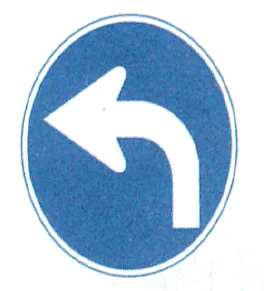
At an intersection where there is a traffic sign as shown in the figure, a vehicle must not execute a right turn or proceed straight through the intersection.
Answer: True
Question 6
Automobiles may cross sidewalks, side strips or bicycle paths to enter or leave roadside locations.
Answer: True
Question 7
When a police officer at an intersection raises his or her arms straight up vertically after holding his or her arms horizontally in an east-west direction, traffic proceeding to the east or west must not, in principle, proceed beyond the designated stop position.
Answer: True
Question 8
If a driver is about to cut off a bicycle when passing one to execute a left turn, he or she may alert the cyclist by sounding the horn and then proceed.
Answer: False
Question 9
There is a wheelbase differential when a vehicle executes a left or right turn.
Answer: True
Question 10
When tires wear down, the braking distance decreases because the ground contact area of tires becomes larger.
Answer: False
Question 11
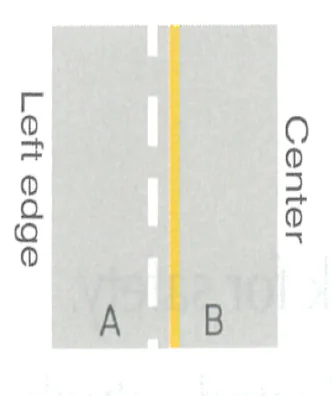
In the vehicular lanes shown in the figure, a vehicle traveling in lane A may change lanes into lane B, but a vehicle traveling in lane B must not change lanes into lane A.
Answer: True
Question 12
When it rains or a driver is tired, the driver must ensure a longer distance between vehicles because the stopping distance becomes longer.
Answer: True
Question 13
On a road with two lanes in each direction, regular motor vehicles must proceed in the right hand lane.
Answer: False
Question 14
Lap belts of a seatbelt should be tightly wrapped around a driver's pelvis, because if wrapped around the abdomen, significant pressure that may be dangerous may be applied to the abdomen in the event of an accident.
Answer: True
Question 15
A driver does not need to give a signal when reversing.
Answer: False
Question 16
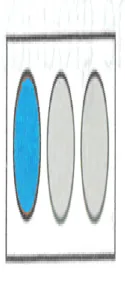
A vehicle proceeding towards a signal as shown in the figure may proceed straight through and execute a left or right turn.
Answer: False
Question 17
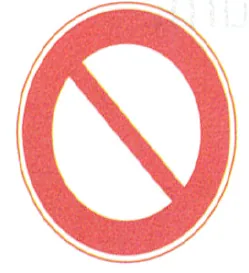
A traffic sign as shown in the figure designates that the road is closed to all traffic.
Answer: False
Question 18
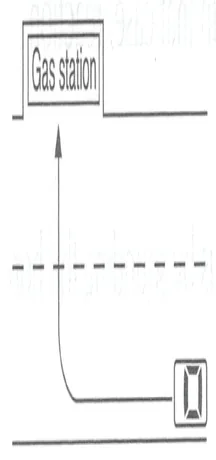
It is correct for a vehicle to proceed as indicated by the arrow in the figure when entering a gas station on the right side of the road.
Answer: False
Question 19
A driver with a regular license may ride a general moped, but may not drive special light equipment.
Answer: False
Question 20
When there is an obstacle on one side of the road, a vehicle on the same side as the obstacle must stop or slow down before the obstacle and give way to a vehicle approaching the obstacle from the other direction.
Answer: True
Question 21
When there is enough passing clearance on the left side of the vehicle ahead, a vehicle may overtake the vehicle ahead by passing on the left side.
Answer: False
Question 22
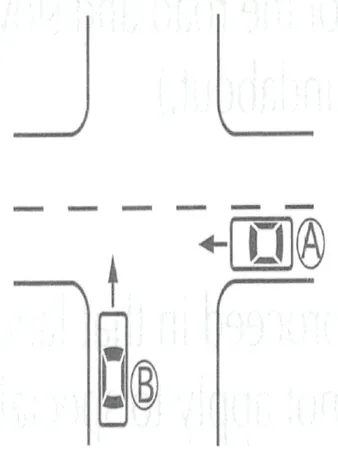
In the situation shown in the figure, vehicle Ⓑ may proceed before vehicle Ⓐ.
Answer: False
Question 23
Even when needed to avoid danger, a vehicle must slow down first before sounding the horn.
Answer: True
Question 24
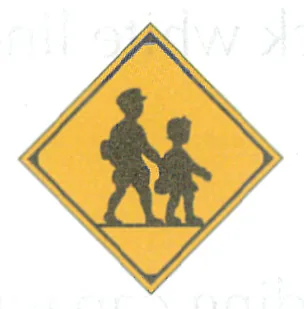
A traffic sign as shown in the figure indicates that there is a pedestrian crossing for students ahead.
Answer: False
Question 25
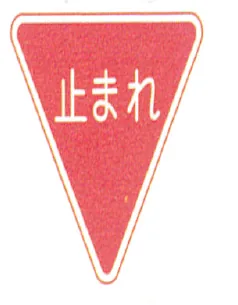
Where there is a traffic sign as shown in the figure, a vehicle must stop even when it is safe to the left and right.
Answer: True
Question 26
When a traffic signal ahead is yellow, a vehicle may proceed while paying attention to other traffic.
Answer: False
Question 27
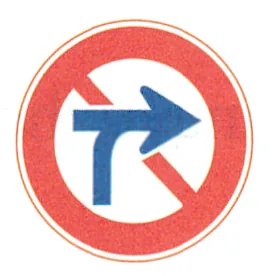
A traffic sign as shown in the figure designates "no U-turn."
Answer: False
Question 28
A vehicle must slow down along a steep downward and upward slope.
Answer: False
Question 29
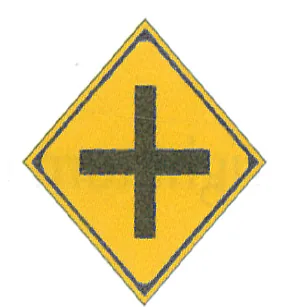
A traffic sign as shown in the figure indicates that there is an intersection ahead.
Answer: True
Question 30
When attempting to overtake, it is advisable for a driver to give a signal by turning on the direction indicator, and then checking safety to the rear.
Answer: False
Questions 31-50
Question 31
Persons who are traveling in a vehicle for those with disabilities, or walking with a guide dog or a white or yellow stick have a physical disability. Vehicles must stop or slow down to allow these persons to pass safely.
Answer: True
Question 32
A lot of vehicles and people use roads, so even if one single driver or pedestrian travels as he or she likes, traffic may become confused and accidents may occur.
Answer: True
Question 33
Overtaking is prohibited at a pedestrian crossing or within 30 meters before one.
Answer: True
Question 34
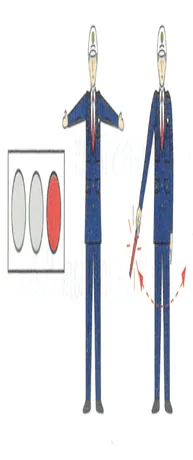
The three traffic signals shown in the figures have the same meaning for traffic proceeding towards the front and back of these signals.
Answer: True
Question 35
When changing lanes on a road with light traffic, a driver must only give a signal and does not need to check for safety.
Answer: False
Question 36
Overtaking refers to changing lanes while proceeding and passing a vehicle traveling ahead, and is a complicated vehicle operation. It is preferable for a driver to attempt overtaking as little as possible.
Answer: True
Question 37
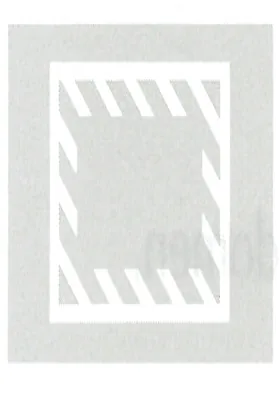
The pavement marking shown in the figure designates a "no entry zone."
Answer: False
Question 38
A driver must carry his or her driver's license or Individual Number Card with driver's license information record (collectively referred to as driver's license and equivalent) while driving. He or she, therefore, must not drive a vehicle on the grounds that they simply forgot to carry it.
Answer: True
Question 39
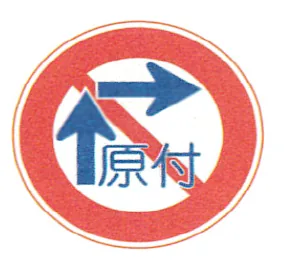
A traffic sign as shown in the figure designates that general mopeds must execute a two-step right turn.
Answer: False
Question 40
When a driver is tired, it will take longer for him or her to respond to danger and make judgments. In that case, reaction distance becomes longer.
Answer: True
Question 41
Even when a local bus stopped at a bus stop gives a signal to enter traffic, a vehicle may pass the bus by sounding the horn to alert the bus.
Answer: False
Question 42
When there is a streetcar stopped on the road, a vehicle may pass it if there are no passengers getting on or off the streetcar in a safety zone.
Answer: False
Question 43
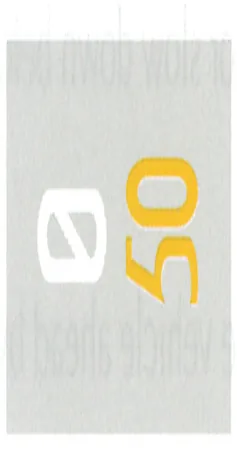
The pavement marking shown in the figure designates the end of a 50 km/h speed limit zone.
Answer: True
Question 44
When executing a right turn on a one-way street, an automobile must initially approach the right edge of the road and slow down inside the center point of the intersection (following arrow markings, if there are any). (Except roundabout.)
Answer: True
Question 45
The designated maximum speed limit for general mopeds is 30 km/h.
Answer: True
Question 46
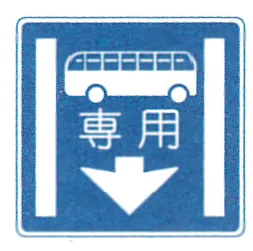
Where there is a traffic sign as shown in the figure, a vehicle other than local buses may proceed in that lane when traffic is light or if there are no local buses in the vicinity of the vehicle. (This does not apply to special light equipment, mopeds and light vehicles.)
Answer: False
Question 47
When stopping before a pedestrian crossing or bicycle crossing, a vehicle must stop immediately before the thick white line (stop line), if there is one before the crossing.
Answer: True
Question 48
After changing lanes, a driver must stop signaling about 3 seconds after the completion of the action.
Answer: False
Question 49
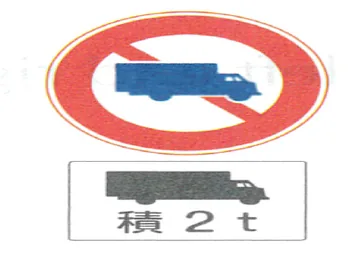
A road where there are traffic signs as shown in the figure is closed to trucks with a maximum loading capacity of 2 tons or more and special heavy equipment.
Answer: True
Question 50
Overtaking a vehicle that is attempting to overtake a general moped is double overtaking.
Answer: False
Frequently asked questions
How many questions are in the Karimen knowledge test?
The Karimen knowledge test for an ordinary licence uses 50 questions, which is why every set on this page contains 50 true/false items.
Is this the same test used for foreign licence conversion?
No. Foreign licence conversion uses its own 50-question knowledge check with 45 correct answers required under the rule that took effect on October 1, 2025. Karimen sets prepare the learner-permit stage.
Can I take these practice questions in other languages?
Yes. The interactive practice app offers the full bank with explanations in seven languages, including Japanese, Chinese, Hindi, Urdu, Sinhala and Nepali.