
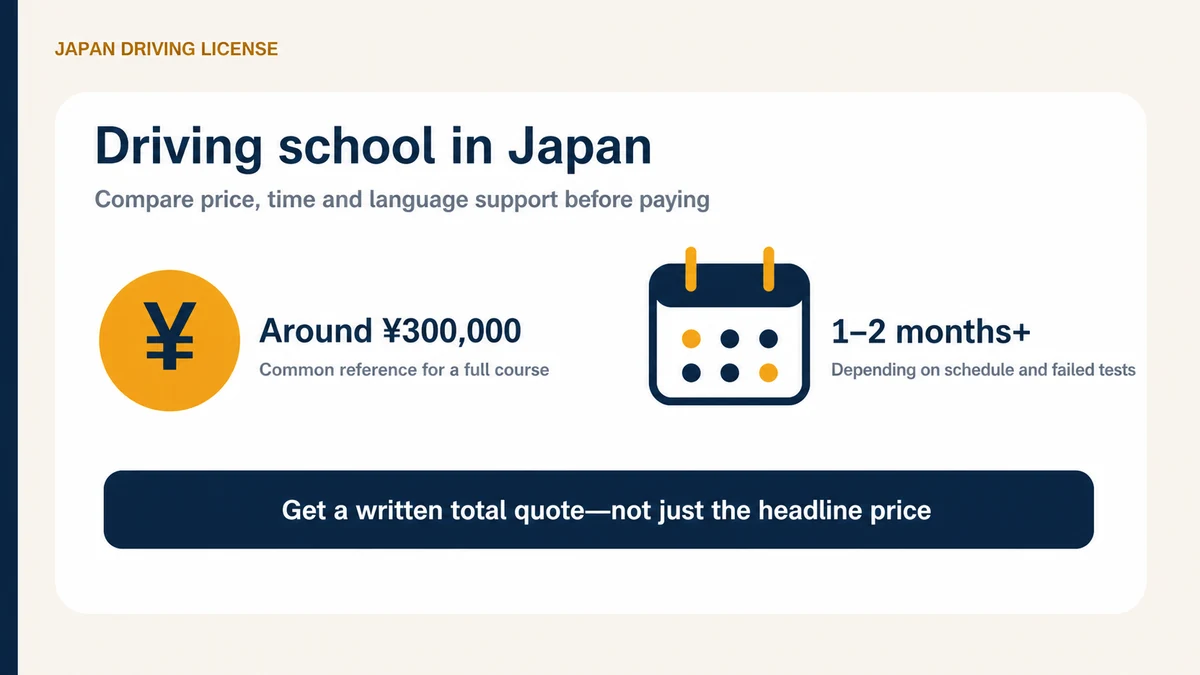
Typical price range
OIST's guide uses approximately ¥300,000 as an average reference for a full designated-school course. Depending on region, season and package, ordinary AT courses are often quoted roughly in the high-¥200,000s to mid-¥300,000s, while manual courses generally cost more.
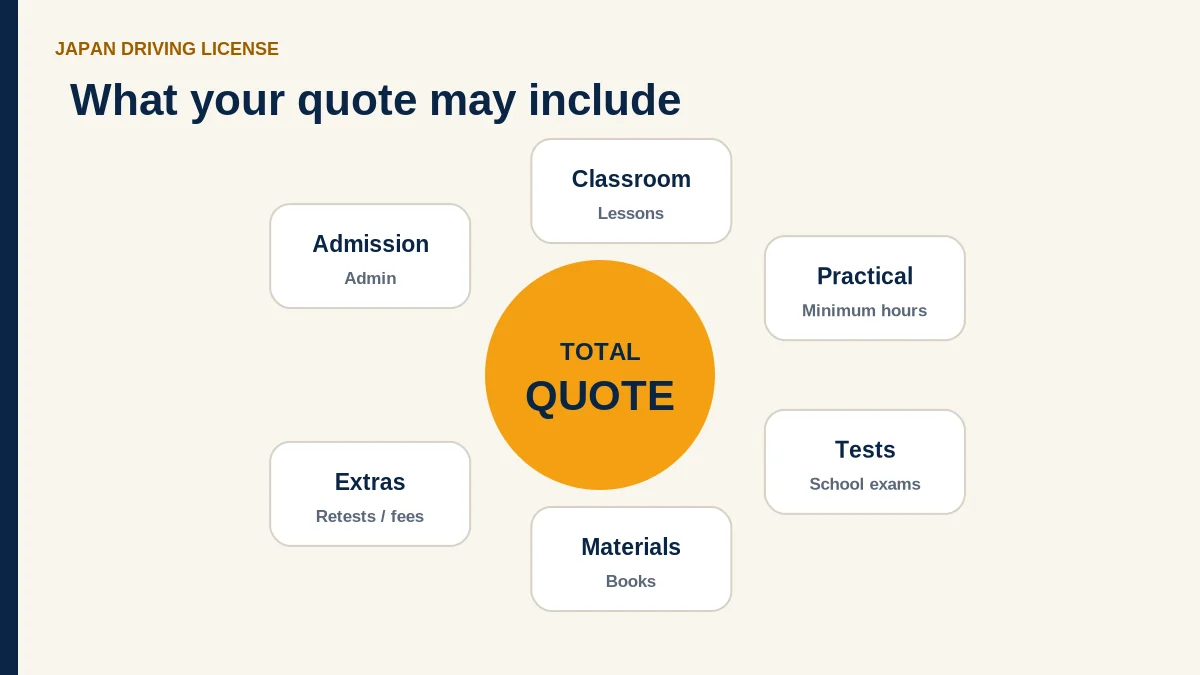
What the quoted price may include
- Admission and administration.
- Classroom lessons.
- Minimum required practical lessons.
- School examinations and graduation test.
- Textbooks and aptitude materials.
- Shuttle bus service.
- Insurance for lessons.
Ask separately about official knowledge-test fees, Karimen-related fees, licence issuance, photographs, retests, cancellation charges, extra practical lessons and accommodation.
How long it takes
| Study style | Typical planning window | Main constraint |
|---|---|---|
| Intensive commuting course | About 1–2 months may be possible | Lesson and test availability |
| Evening/weekend commuting | Several months | Your schedule and booking competition |
| Residential licence camp | Often structured into a concentrated schedule | Eligibility, language and fixed attendance dates |
Completion time is affected by missed lessons, failed school tests, seasonal demand, weather and the final licence-centre reservation.
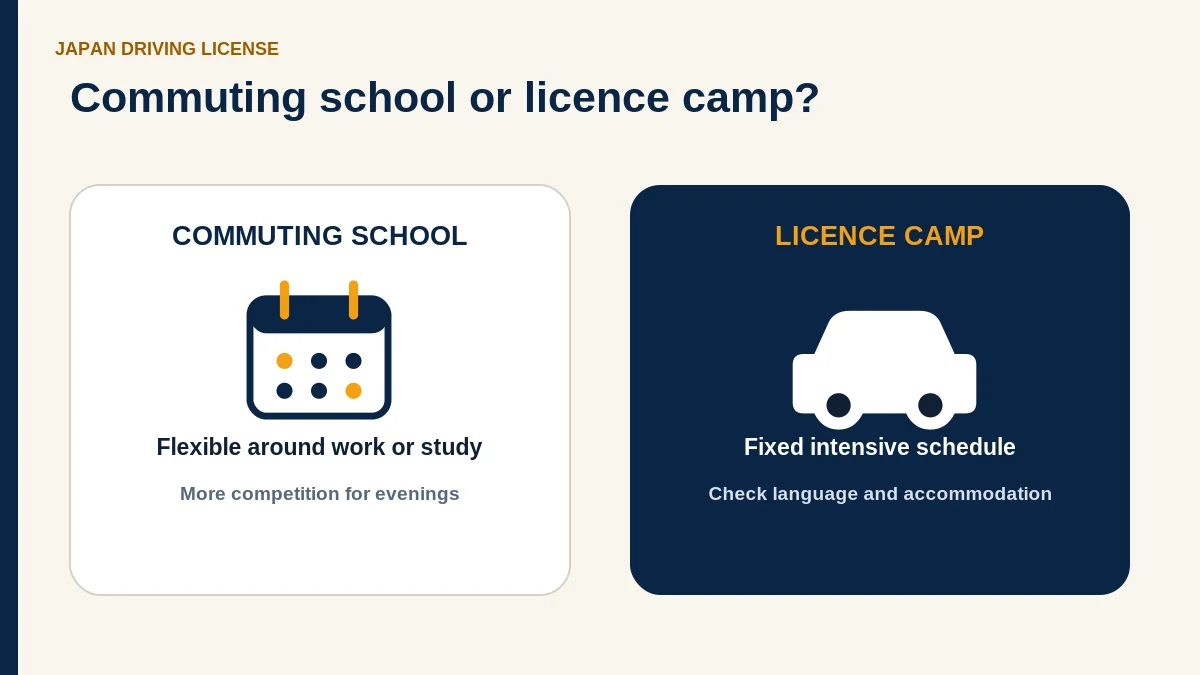
Commuting school or licence camp?
Commuting schools let you continue work or study and may provide local shuttle buses. The downside is competition for after-work and weekend lessons.
Licence camps (gasshuku) combine accommodation with a fixed intensive timetable. They can be efficient, but foreign residents should verify language support, dietary needs, residency restrictions, included transport and what happens after a failed test.
How to judge English or foreign-language support
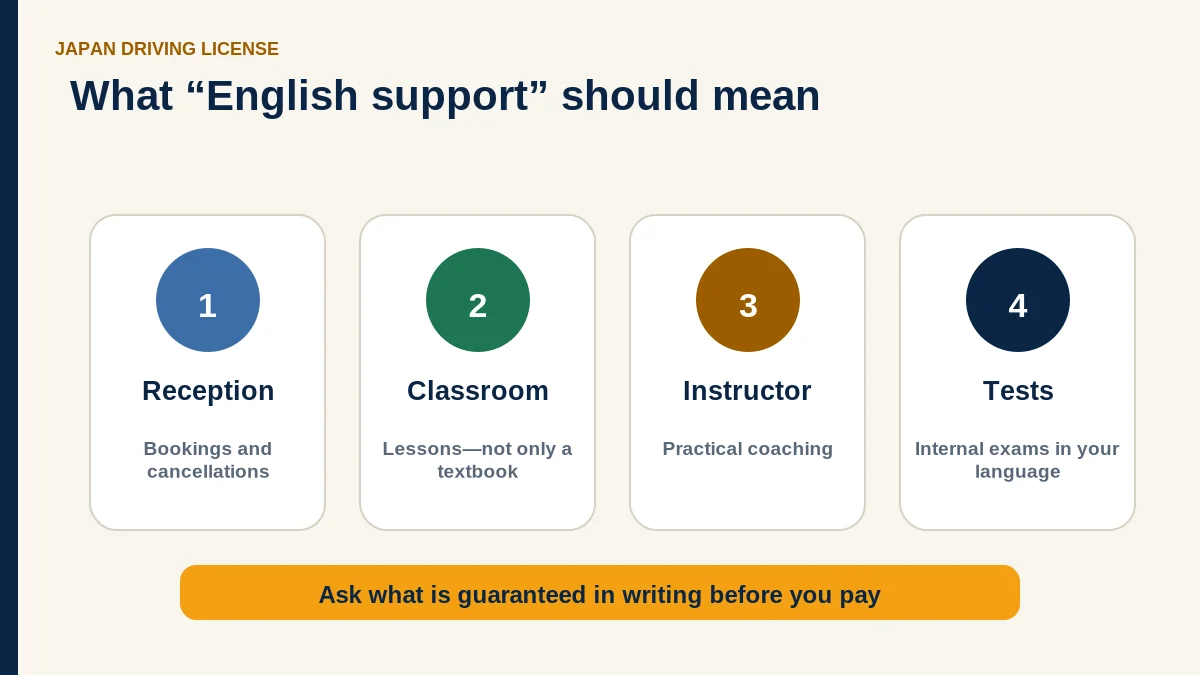
“English support” can mean anything from an English brochure to a fully bilingual instructor. Ask:
- Are classroom lessons available in English, or only the textbook?
- Can the reception desk explain bookings and cancellations in your language?
- Are practical instructors bilingual?
- Are internal tests available in your language?
- Can the school help book the final official test?
- Are signs and technical terms taught in Japanese as well?
Questions to ask before paying
- What is the total price if I pass every stage first time?
- Which charges are not included?
- How much are extra practical lessons and retests?
- How long is the current waiting time for lessons?
- When does the contract or lesson validity expire?
- What refund is available if I move or withdraw?
- Is the school officially designated?
- What language support is guaranteed in writing?
Frequently asked questions
Can a foreigner join any Japanese driving school?
Many schools accept foreign residents, but language, residence-status and document requirements differ. Contact the school before paying.
Is a licence camp always cheaper?
Not always. Compare transport, room type, seasonal surcharge, extra-night rules and language support.
Does the school issue the final licence?
A designated school can conduct most training and the graduation skills test, but the final knowledge test and licence issuance are handled through the prefectural system.
Should I choose manual or AT?
Choose manual only if you genuinely need it. AT is enough for most private cars and often requires fewer practical lessons.
Official and supporting sources
- OIST: school cost and time comparison
- Ziplus Road Ready: driving-camp and licence content topics
- Tokyo Metropolitan Police: official examination fee examples
Information was reviewed on July 17, 2026. Procedures, fees, languages and booking systems can vary by prefecture. Confirm details with the police authority responsible for your registered address before travelling.
What to ask before comparing driving-school quotes
- Compare the same transmission, existing-licence status and residential or commuting plan.
- Ask which extra lessons, retests and cancellation charges are excluded.
- Confirm lesson availability, likely completion time and language support before paying.
Check licence-age eligibility before enrolling · Start learning with free explained questions
Share this guide
Share this guide with another learner or save it for later.