
Karimen Practice Test Set 3 — 50 Learner Permit Questions
This free practice set contains 50 Karimen questions in the same true/false format as the real knowledge test. The heaviest categories here are safe driving (9), road signs (8), traffic signals (7).
16 of the questions include road figures — signs, junction layouts and signal scenes — exactly the kind of visual items that cost marks when you meet them for the first time.
Read each explanation before moving on: every answer links back to the rule being tested. When you can score above 90% here, run the same set against the clock inside the free practice app.
Questions 1-30
Question 1
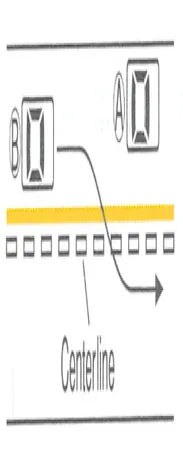
When attempting to overtake vehicle Ⓐ, vehicle Ⓑ may cross the centerline.
Answer: False
Question 2
When opening the door of the vehicle to get out, first open it slightly while checking the safety to the rear, and ensure safety before fully opening the door.
Answer: True
Question 3
A driver must maintain a safe distance between his or her vehicle and the vehicle ahead, taking the weather, road and tire conditions, and the weight of the cargo loaded into account, so as not to collide with the vehicle ahead if it stops suddenly.
Answer: True
Question 4
The signal to be given when moving into traffic after parking at the left edge of the road is the same as that given when intending to move into the lane to the right while traveling straight.
Answer: True
Question 5
When passing through a railway crossing, it is advisable for a driver not to shift gears and proceed straight through the crossing in the gear used when starting the vehicle.
Answer: True
Question 6
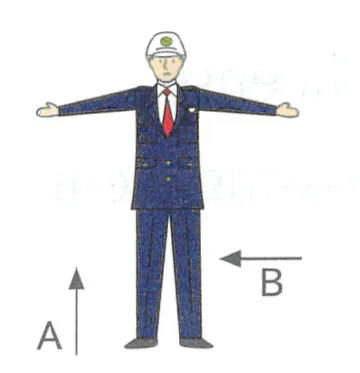
When the hand signal shown in the figure is made, the traffic proceeding in direction A must stop at the designated position, however, the traffic proceeding in direction B may go ahead.
Answer: True
Question 7
Passing too close to or cutting in front of a regular vehicle that is displaying a sign indicating a novice driver, senior driver, learner driver or physically disabled driver is, in principle, prohibited.
Answer: True
Question 8
When a traffic signal turns green but the vehicle ahead does not move, a driver may sound the horn so as to urge the driver of the vehicle ahead to start.
Answer: False
Question 9
When passing a vehicle stopped on the road, a driver must ensure safety, slow down or maintain enough space between his or her vehicle and the stopped vehicle, and anticipate that a door of the vehicle may suddenly open.
Answer: True
Question 10
On a road where there are no vehicular lanes designated, automobiles may proceed anywhere to the left of the centerline of the road.
Answer: False
Question 11
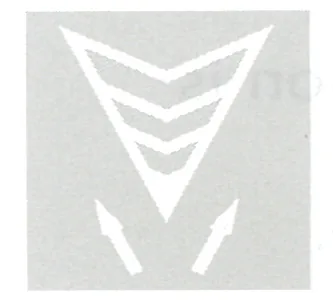
A pavement marking shown in the figure indicates that there is an obstruction on the road ahead.
Answer: True
Question 12
When being overtaken by the vehicle behind, it is safe not to increase speed and give way until the vehicle completes overtaking, regardless of the type of that vehicle.
Answer: True
Question 13
On a road where the road and the sidewalks are not separated, vehicles must slow down when passing near a pedestrian.
Answer: False
Question 14
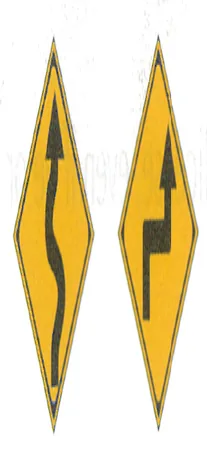
Where there are warning signs as shown in the figures, a vehicle must proceed while sounding the horn.
Answer: False
Question 15
If the brake pedal is depressed several times, the brake lamps flash, which serves as a signal to drivers behind. As a result, it can help prevent a rear end accident.
Answer: True
Question 16
On a road with two lanes in each direction, all types of vehicle must proceed in the left lane and keep the right lane free for vehicles overtaking or executing a right turn.
Answer: True
Question 17
The three keys to driving are: identification, judgment and execution. Among them, execution is especially important and deeply related to causes of an accident.
Answer: False
Question 18
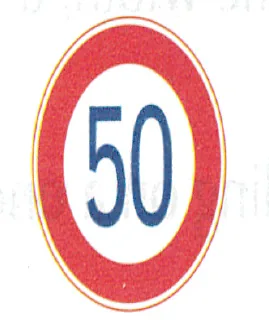
On a road where there is a traffic sign as shown in the figure, automobiles and general mopeds may proceed at a speed of 50 km/h.
Answer: False
Question 19
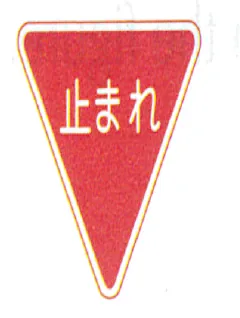
Where there is a traffic sign as shown in the figure, vehicles must stop immediately before the sign and check for safety.
Answer: False
Question 20
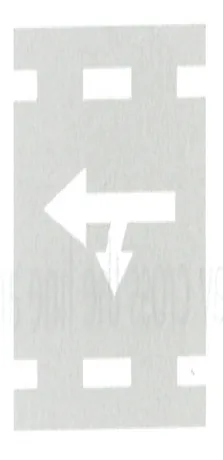
Vehicles may execute a right turn from a vehicular lane where there is a pavement marking as shown in the figure.
Answer: False
Question 21
A driver must carry his or her driver's license and equivalent (including learner's permit) while driving a vehicle so as to be able to present it at anytime.
Answer: True
Question 22
When overtaking a vehicle proceeding near the centerline for executing a right turn, vehicles must pass on the right side of that vehicle.
Answer: False
Question 23
When there is a streetcar stopped where there is no safety zone, a vehicle must stop behind the streetcar until all the passengers finish getting on and off or finish crossing the road.
Answer: True
Question 24
Vehicles do not have to stop immediately before crossing sidewalks or side strips if no pedestrians are present.
Answer: False
Question 25
A driver must not drive a vehicle assuming that everyone on the road behaves perfectly. Rather, he or she must always anticipate the possibility of danger.
Answer: True
Question 26
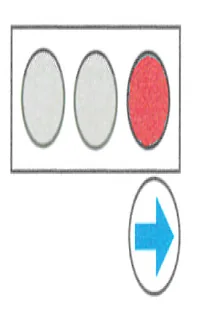
At a traffic signal as shown in the figure, automobiles and general mopeds may execute a right turn (unless a two-step right turn is designated for mopeds).
Answer: True
Question 27
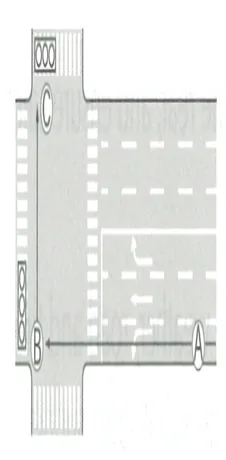
When making a right turn at an intersection as shown in the figure, a general moped must proceed straight ahead from point Ⓐ to point Ⓑ, turn to the right and proceed straight ahead when traffic signal Ⓒ ahead turns green.
Answer: True
Question 28
The designated maximum speed on general roads is 60 km/h for regular passenger vehicles, but 50 km/h for regular trucks.
Answer: False
Question 29
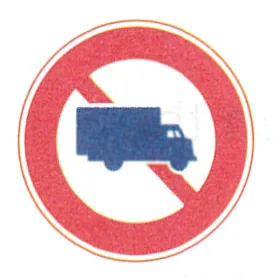
A road where there is a traffic sign as shown in the figure is closed to large-size trucks, specified medium trucks, and special heavy equipment.
Answer: True
Question 30
Driver's licenses are classified into three types; the first-class license, the second-class license and the moped license.
Answer: False
Questions 31-50
Question 31
At a place other than an intersection and where there is no pedestrian crossing, bicycle crossing or railway crossing, vehicles must stop 3 meters before a police officer or traffic warden who is giving a stop signal.
Answer: False
Question 32
A steep downward slope is suitable for overtaking because it is easy to accelerate.
Answer: False
Question 33
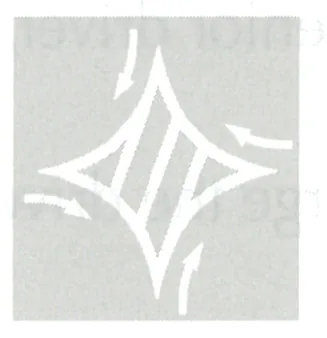
When executing a right turn at an intersection where there is a pavement marking as shown in the figure, automobiles must slow down and proceed following the arrows.
Answer: True
Question 34
When moving into traffic from the edge of the road, it is not particularly necessary to signal if the driver makes sure there are no vehicles approaching from the rear.
Answer: False
Question 35
While driving, it is good for a driver to take a relaxed posture looking straight ahead and leaning lightly against the back of the seat.
Answer: True
Question 36
When changing the vehicle movements during driving, a driver must signal and continue signaling until the action is completed.
Answer: True
Question 37
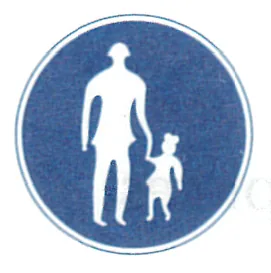
Any type of vehicle must not proceed on a road where there is a traffic sign as shown in the figure.
Answer: False
Question 38
When a driver approaches a pedestrian crossing and is not sure whether or not there are pedestrians crossing, he or she must reduce speed enough to be able to stop before entering the pedestrian crossing.
Answer: True
Question 39
If one drives without carrying driver's license and equivalent, it is regarded as driving without a valid license, even if he or she is licensed.
Answer: False
Question 40
When there is a flashing yellow traffic light ahead, vehicles must slow down and proceed.
Answer: False
Question 41
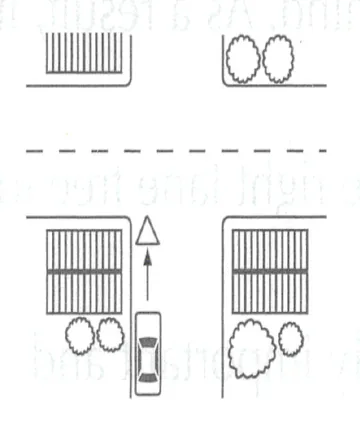
In the situation shown in the figure, the vehicle must slow down at the point shown by △.
Answer: True
Question 42
When approaching an intersection (except roundabout) that has no traffic signals and the two streets are the same width, a vehicle must not obstruct the progress of a vehicle approaching from the right.
Answer: False
Question 43
When giving way to an emergency vehicle, a vehicle must move to the left side of the road even when proceeding on a one-way road.
Answer: False
Question 44
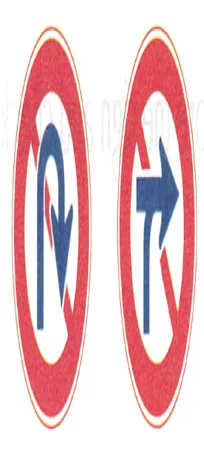
Reversing is also prohibited where there is either or both of the two traffic signs shown in the figure.
Answer: False
Question 45
A driver may select any type of clothing for driving as long as he or she is not naked.
Answer: False
Question 46
Even when proceeding on a road where the vehicular lanes are designated by a yellow line, a vehicle may cross the line and change lanes so as to execute a left or right turn.
Answer: False
Question 47
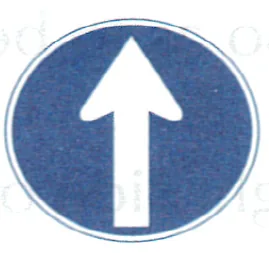
A vehicle must not execute a left or right turn at an intersection where there is a traffic sign as shown in the figure.
Answer: True
Question 48
Overtaking the vehicle ahead when that vehicle is attempting to overtake another automobile is double overtaking. This type of overtaking is prohibited because it is dangerous.
Answer: True
Question 49
A driver needs to check the safety to the rear not only by using the rearview mirror, but in some cases also by checking the side where there may be danger directly with his or her eyes.
Answer: True
Question 50
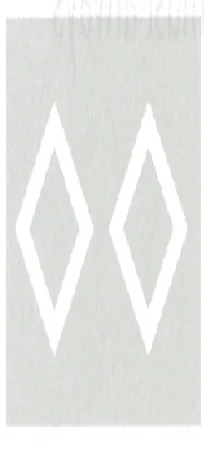
The pavement marking shown in the figure indicates that there is an intersection ahead.
Answer: False
Frequently asked questions
How many questions are in the Karimen knowledge test?
The Karimen knowledge test for an ordinary licence uses 50 questions, which is why every set on this page contains 50 true/false items.
Is this the same test used for foreign licence conversion?
No. Foreign licence conversion uses its own 50-question knowledge check with 45 correct answers required under the rule that took effect on October 1, 2025. Karimen sets prepare the learner-permit stage.
Can I take these practice questions in other languages?
Yes. The interactive practice app offers the full bank with explanations in seven languages, including Japanese, Chinese, Hindi, Urdu, Sinhala and Nepali.