
Honmen Practice Test Set 4 — 90 Final Exam Questions
This free practice set contains 90 Honmen questions in the same true/false format as the real knowledge test. The heaviest categories here are vehicle handling (19), road signs (14), general rules (11).
17 of the questions include road figures — signs, junction layouts and signal scenes — exactly the kind of visual items that cost marks when you meet them for the first time.
Read each explanation before moving on: every answer links back to the rule being tested. When you can score above 90% here, run the same set against the clock inside the free practice app.
Questions 1-30
Question 1
When moving into the lane to the right while traveling straight ahead, a driver should signal 30 meters before reaching the point at which he or she intends to change lanes.
Answer: False
Question 2
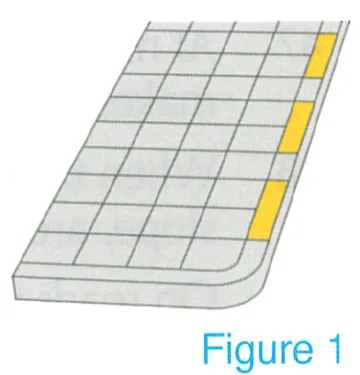
Where there is a yellow pavement marking on the sidewalk as shown in Figure 1, vehicles may stop to allow people to get out.
Answer: True
Question 3
Holders of regular first-class licenses may not drive for the purpose of operating a taxi or other chauffeured vehicle, but may drive for the purpose of returning the vehicle without carrying passengers.
Answer: True
Question 4
For regular trucks with an engine displacement of 660 cc, cargo may be loaded up to a height of 2.5 meters above the ground.
Answer: True
Question 5
When the road surface is dry, drivers of two-wheeled vehicles should apply the rear wheel brakes rather forcefully, but when it is slippery, they should apply the front wheel brakes rather forcefully.
Answer: False
Question 6
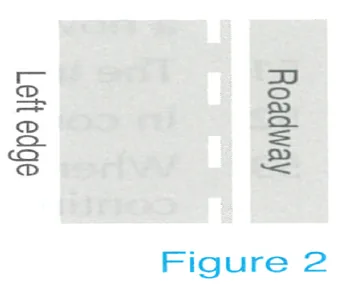
Where there is a side strip as shown in Figure 2, special specified small mopeds or light vehicles may not proceed.
Answer: False
Question 7
One may dismount from a two-wheeled vehicle and push it along while walking on a sidewalk or pedestrian crossing even with the engine running.
Answer: False
Question 8
Suddenly swerving from the left lane into the right-turn lane is extremely dangerous, so when drivers of large-size or regular motorcycles change lanes in order to turn right on a wide street, they should move to the right-turn lane gradually and sufficiently in advance of the intersection.
Answer: True
Question 9
When planning to drive on an expressway, drivers should pay particular attention to prior inspections to ensure that they are not forced to stop on the expressway due to insufficient fuel or coolant, low engine oil, etc.
Answer: True
Question 10
The "maximum speed limit" traffic sign is a regulatory sign and the "no stopping zone" pavement marking is a designation marking.
Answer: False
Question 11
To start the engine of an automatic transmission vehicle, the driver should engage the handbrake, check that the gear shift is in the (P) position, and depress the brake pedal.
Answer: True
Question 12
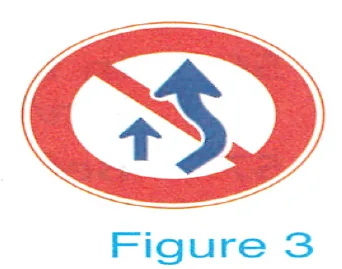
Where there is a traffic sign as shown in Figure 3, vehicles may overtake the vehicle in front of them if they do not enter the right side of the road.
Answer: True
Question 13
Traffic accidents are the responsibility of the driver who caused the accident only, and not at all the responsibility of the person who lent the vehicle.
Answer: False
Question 14
Overtaking is prohibited at a pedestrian crossing or bicycle crossing or within 30 meters before and after one.
Answer: False
Question 15
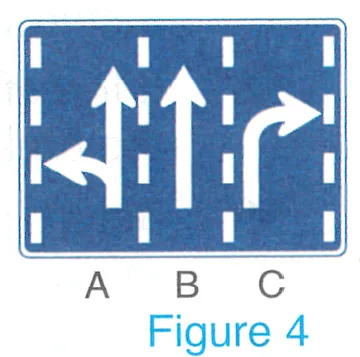
Where there is a sign as shown in Figure 4, vehicles traveling in the lanes indicated by B or C may continue in their designated lanes even if emergency vehicles are approaching from behind. They do not need to change lanes.
Answer: False
Question 16
When approaching the rear of a streetcar stopped at a streetcar stop where there is no safety zone but no people are getting on or off, drivers may slow down and proceed regardless of the space between their vehicle and the streetcar.
Answer: False
Question 17
When executing a reverse, drivers must signal when intending to reverse.
Answer: True
Question 18
When a police officer is holding both of his or her arms straight up vertically at an intersection, this has the same meaning as a red light for traffic crossing the path of traffic proceeding parallel to the stance of the police officer.
Answer: True
Question 19
If a four-wheeled vehicle's engine stalls or won't start inside a railway crossing, intersection, or similar, the driver should move the vehicle by shifting to a low gear and using the starter motor without depressing the clutch pedal as an emergency measure. (This does not apply to automatic transmission vehicles or manual transmission vehicles equipped with a clutch start switch.)
Answer: True
Question 20
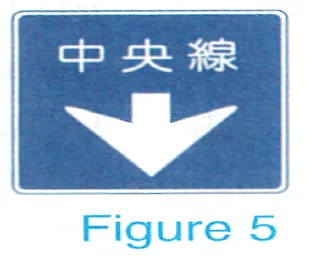
The traffic sign shown in Figure 5 indicates the centerline, which is not necessarily located in the physical center of the road.
Answer: True
Question 21
If a traffic accident occurs, regardless of the cause, a driver should first stop the vehicle, assist anyone who is injured, and take appropriate measures to prevent follow-on accidents.
Answer: True
Question 22
People who have held a regular motorcycle license for less than one year must not drive a regular motorcycle while carrying a second passenger.
Answer: True
Question 23
To calculate the seating capacity of an automobile, count two children under 12 years of age as one adult.
Answer: False
Question 24
Drivers cannot drive safely if they do not have a reliable awareness of information about road and traffic conditions. Most information can be obtained through observation, so sight is the most important of all human senses when driving.
Answer: True
Question 25
If an emergency vehicle is approaching a location other than near an intersection and a driver yields the road by moving to the left side of the road, it is not absolutely necessary for the driver to come to a stop (except for on one-way streets).
Answer: True
Question 26
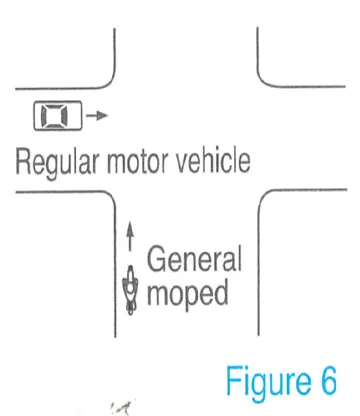
At an intersection that has no traffic control as shown in Figure 6, the regular motor vehicle approaching from the left of the general moped has the right of way.
Answer: False
Question 27
The braking effect of engine braking is greater in high gears than in low gears.
Answer: False
Question 28
Road surface and tire condition are closely related to frictional force and have a significant effect on stopping distance.
Answer: True
Question 29
If the foot brake of a four-wheeled vehicle fails on a downward slope, pulling the handbrake will not have any effect, so the only way to stop is to allow the wheels to drop down into the ditch along the mountain-side of the road or into the sand at the side of the road, etc.
Answer: False
Question 30
Vehicles cannot stop instantly, so drivers should drive at a speed that constantly takes into account reaction distance and braking distance.
Answer: True
Questions 31-60
Question 31
If a regular motor vehicle is unavoidably forced to stop and park on an expressway due to a breakdown, etc. at night, the driver need not turn on the hazard lights, parking lights, or tail lamps if he or she puts out an emergency warning reflector device.
Answer: False
Question 32
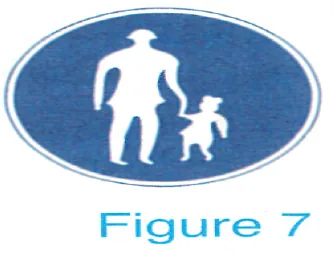
On a road where there is a traffic sign as shown in Figure 7, drivers who have obtained the permission of the police chief may proceed, but they must slow down whether there are any pedestrians or not.
Answer: True
Question 33
Vehicles may not stop on the left side of a safety zone or within 10 meters of the front or rear left side of a safety zone, even to let passengers get in or out.
Answer: True
Question 34
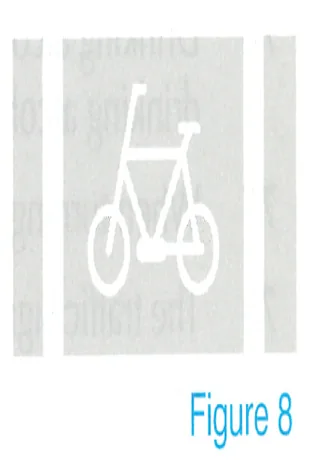
The pavement marking shown in Figure 8 designates an exclusive lane for bicycles.
Answer: False
Question 35
When a vehicle slips on a rainy day after the brakes are applied, the driver should think that the brakes are not working properly and apply them forcefully once more.
Answer: False
Question 36
When there is an obstacle on the road ahead and vehicles will pass one another near it, the vehicle that can pass that point first has right of way.
Answer: False
Question 37
If an automatic transmission vehicle proceeds down a long slope with the gear shift in (D) (drive), engine braking will not be very effective and the driver will depend on the foot brake too much. This is dangerous, as the brake drums and brake linings will heat up, the vapor lock phenomenon will occur, and the brakes will suddenly fail.
Answer: True
Question 38
When traveling in the main through lane of an expressway, drivers should proceed slightly to the right of the center of the lane because using the white line at the right as a guideline gives the driver a good perspective.
Answer: False
Question 39
When the signal directly facing traffic is a red light and a yellow arrow, automobiles may proceed in the direction indicated by the arrow.
Answer: False
Question 40
When proceeding straight through an intersection on a two-wheeled vehicle, four-wheeled vehicles ahead may suddenly turn left, so the driver of the two-wheeled vehicle should pay careful attention to the movements of four-wheeled vehicles so as to avoid being hit or cut off.
Answer: True
Question 41
Throwing rubbish such as cigarette butts, paper scraps, or empty cans out of a vehicle is prohibited, as is putting any part of one's body or any object outside a vehicle while it is moving.
Answer: True
Question 42
Actions causing undue noise that can disturb other people, jack-rabbit starts, abrupt acceleration, and racing the engine are not permitted.
Answer: True
Question 43
To give a hand signal for turning right, the driver should signal with the right arm from the right side of the vehicle extended straight, parallel to the ground, or with the left arm from the left side of the vehicle with the elbow bent at 90 degrees and hand pointing to the sky. (Except roundabout.)
Answer: True
Question 44
When the vehicle ahead is attempting to overtake another automobile, a driver may overtake that vehicle if there is sufficient space for overtaking to the right of it and safety can be ascertained.
Answer: False
Question 45
In congested traffic, a driver may have to enter and stop inside a pedestrian crossing or bicycle crossing.
Answer: False
Question 46
When driving in a location such as the exit of a dugway or tunnel on an expressway, side winds may cause the steering wheel to pull to one side, so drivers must be careful.
Answer: True
Question 47
At night it is difficult to see one's surroundings, so approaching the vehicle ahead as closely as possible to ensure an operative field of vision makes driving easier and safer.
Answer: False
Question 48
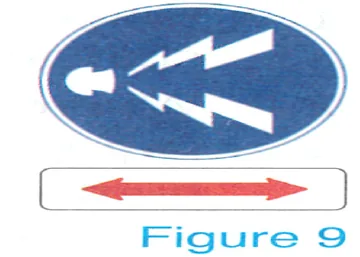
When traveling on a road where there is a traffic sign as shown in Figure 9, vehicles must sound their horns when driving at the top of an upward slope, around corners of roads, or at intersections where it is difficult to see ahead.
Answer: True
Question 49
On roads with three or more lanes for traffic traveling in the same direction, drivers should choose the lane with the lightest traffic and proceed.
Answer: False
Question 50
When an oncoming vehicle is crossing the centerline to overtake another vehicle, a driver has no choice except to cut in front of a vehicle that is displaying a novice driver sign.
Answer: True
Question 51
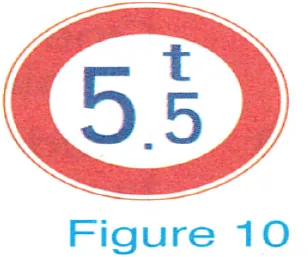
The traffic sign shown in Figure 10 means that vehicles carrying cargo that weighs more than 5,500 kilograms may not proceed.
Answer: False
Question 52
In conducting daily checks, it is not necessary to go so far as to check the condition of the engine at low speeds and high speeds.
Answer: False
Question 53
When a four-wheeled vehicle has overtaken the vehicle ahead and is about to change lanes to the left on a general road, the driver should continue forward until the passed vehicle becomes visible in the rearview mirror and then change lanes.
Answer: True
Question 54
Correct driving posture enables reliable driving performance and reduces fatigue, so drivers should not relax their driving posture by tilting their body or driving with their elbow resting on the window ledge.
Answer: True
Question 55
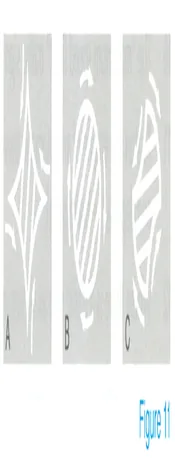
The pavement markings A, B, and C shown in Figure 11 all designate right turn routes at an intersection.
Answer: True
Question 56
In the main through lanes of national expressways, the maximum speed limit for all regular motor vehicles is 100 km/h.
Answer: False
Question 57
Before proceeding through a railway crossing, the driver should bring the vehicle to a complete stop just before the railway crossing and check the areas to the left and right to ensure it is safe to proceed. In addition, the driver should check for traffic congestion on the other side of the railway crossing, and if the vehicle's progress may be halted while still inside the crossing, the vehicle must not enter the railway crossing.
Answer: True
Question 58
If forcefully depressing the brake pedal in a vehicle with hydraulic brakes feels squishy, as if one were stepping on a sponge, there is air in the brake fluid and the brakes will not work properly.
Answer: True
Question 59
Before passing a school bus or kindergarten bus that is stopping to let children on or off, the driver must come to a complete stop behind the bus and check for safety.
Answer: False
Question 60
When carrying cargo in a truck and one person required to observe the cargo is riding in the cargo bed, permission from the chief of police is not required.
Answer: True
Questions 61-90
Question 61
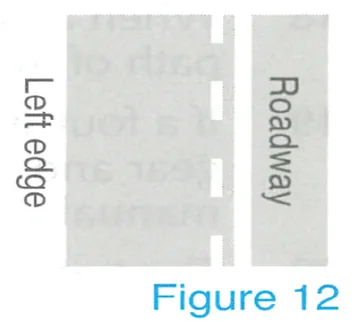
Where there is a side strip as shown in Figure 12, a vehicle may enter the side strip to stop and park if there will be 0.75 meters or more of space on the left side of the vehicle.
Answer: False
Question 62
Causing a traffic accident places serious burdens, such as economic loss and psychological pain, on not only the person who caused the accident but also his or her family.
Answer: True
Question 63
On general roads where no maximum speed limit is indicated by traffic signs or pavement markings, the maximum speed limit for regular motor vehicles with an engine displacement of 660 cc is 60 km/h.
Answer: True
Question 64
Vehicles do not need to slow down along a steep upward slope, but must slow down along a steep downward slope.
Answer: True
Question 65
When a vehicle with a structure and apparatus for towing is towing a vehicle with a structure and apparatus for being towed that has a gross weight of 750 kg, a towing license is required.
Answer: False
Question 66
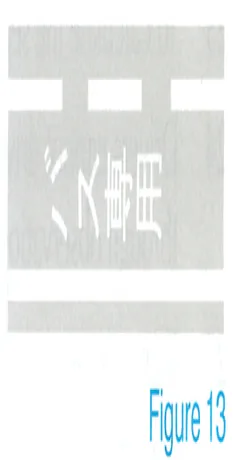
When a lane is designated by a pavement marking as shown in Figure 13, automobiles other than local buses may not proceed except when turning left or right, or when unavoidably forced to due to construction, etc. (This does not apply to special light equipment.)
Answer: True
Question 67
If a police officer is making the hand signal for "stop" at an intersection, vehicles should stop one meter before the police officer.
Answer: False
Question 68
Even at the same distance, small vehicles appear closer and large vehicles appear further away than they actually are. Even traveling at the same speed, objects appear faster at night than during the day.
Answer: False
Question 69
There are many dangerous places on busy urban roads at night, so drivers should always use the high beams and pay careful attention to what is ahead as they proceed.
Answer: False
Question 70
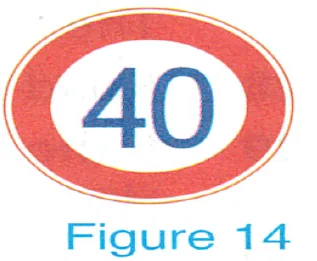
On a road where there is a traffic sign as shown in Figure 14, regular passenger vehicles and large-size trucks must not drive at a speed exceeding 40 km/h.
Answer: True
Question 71
Even if there is danger of a head-on collision, vehicles must not leave the road.
Answer: False
Question 72
When stopping or parking on a road when there is neither a sidewalk nor a side strip, vehicles must leave 0.5 meters or more of space on the left side of the vehicle for pedestrians to pass through.
Answer: False
Question 73
When riding a large-size or regular motorcycle, drivers should place the arch of their foot on the step, keep the soles of their feet roughly flat, point their toes straight forward, and press their knees against the fuel tank.
Answer: True
Question 74
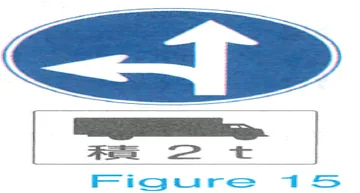
The traffic sign shown in Figure 15 prohibits right turns for large-size trucks, specified medium trucks, and special heavy equipment, so other vehicles may turn right.
Answer: False
Question 75
When an emergency vehicle is entering or leaving the main through lane, other vehicles must not obstruct its progress.
Answer: True
Question 76
Drinking alcohol causes one's sense of judgment and alertness to diminish and one's ability to drive deteriorates, so people must not drive after drinking alcohol, however little they drink.
Answer: True
Question 77
When turning a curve while riding a two-wheeled vehicle, the rider should tilt the vehicle body outward.
Answer: False
Question 78
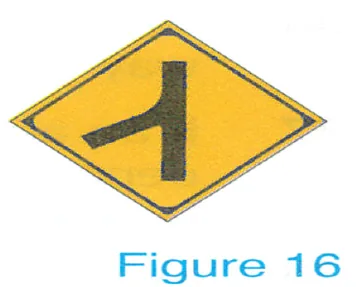
The traffic sign shown in Figure 16 indicates that traffic will converge ahead, which means that vehicles may enter from the left ahead, so drivers must proceed with due caution.
Answer: True
Question 79
When making a U-turn, drivers should signal 30 meters before reaching the point where the U-turn will be made. (Except roundabout.)
Answer: True
Question 80
When waiting at a traffic signal and the signal changes from red to green, other vehicles or remaining pedestrians may ignore the light and attempt to proceed aggressively, so drivers must carefully check for safety before proceeding.
Answer: True
Question 81
The effectiveness of brakes may deteriorate just after passing through a deep puddle of water, so it is necessary to test the brakes' effectiveness.
Answer: True
Question 82
When a pedestrian or bicycle is crossing or is about to cross at a pedestrian crossing or bicycle crossing, vehicles must stop before entering the pedestrian crossing or bicycle crossing (behind the stop line if one exists) and allow the pedestrian or bicycle to cross the road.
Answer: True
Question 83
On parts of national expressways where main through lanes traveling in opposite directions are not separated by a physical divider, the maximum speed limit is the same as on general roads.
Answer: True
Question 84
There is no need to slow down when driving past a safety zone where no people are present.
Answer: True
Question 85
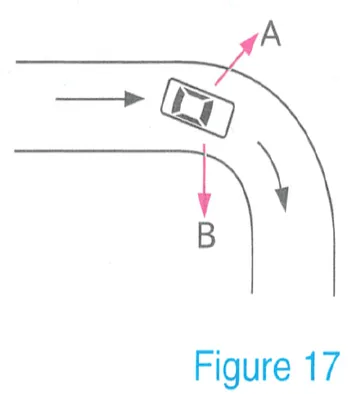
When traveling around a curve as shown in Figure 17, centrifugal force operates in the direction of B.
Answer: False
Question 86
If there is an accident in which no people were injured and only property was damaged, it is not necessary to report the accident to the police if the drivers involved can reach an agreement.
Answer: False
Question 87
When taking a drive, drivers can make the best use of time by driving as necessary according to conditions rather than making a detailed plan.
Answer: False
Question 88
Large automobiles have larger blind spots than small automobiles, and trucks have larger blind spots than passenger vehicles. When these vehicles are loaded with cargo, that cargo affects blind spots.
Answer: True
Question 89
When passing an oncoming vehicle near a pedestrian crossing at night, even if no pedestrians can be seen crossing, pedestrians near the center of the road sometimes cannot be seen by the lights of one's own vehicle and the lights of the oncoming vehicle. Therefore, just in case, drivers should decrease speed before proceeding.
Answer: True
Question 90
When traveling at high speed, the higher the center of gravity of the vehicle's cargo, the greater the driving stability.
Answer: False
Frequently asked questions
Why are there 90 Honmen questions in each set?
The official written examination is commonly described as 95 questions: 90 written true/false items plus five hazard-prediction illustration problems. These sets focus on the 90 written items.
What is the pass standard for the Honmen written exam?
Official materials commonly refer to a 90-point pass standard across the written and hazard-prediction sections. Confirm the current standard with your prefectural licence centre.
Should I study Karimen sets as well?
Yes. Honmen questions assume the rules tested at the Karimen stage, so the five Learner Permit sets remain useful revision while you prepare for the full licence exam.