
Honmen Practice Test Set 3 — 90 Final Exam Questions
This free practice set contains 90 Honmen questions in the same true/false format as the real knowledge test. The heaviest categories here are vehicle handling (20), pedestrians (12), general rules (11).
16 of the questions include road figures — signs, junction layouts and signal scenes — exactly the kind of visual items that cost marks when you meet them for the first time.
Read each explanation before moving on: every answer links back to the rule being tested. When you can score above 90% here, run the same set against the clock inside the free practice app.
Questions 1-30
Question 1
When turning the steering wheel while traveling around a corner or curve, if speed increases three times centrifugal force increases six times.
Answer: False
Question 2
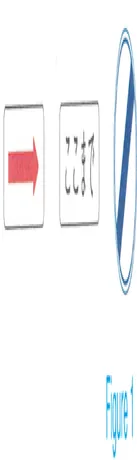
The three auxiliary signs shown in Figure 1 express the same meaning.
Answer: False
Question 3
When driving at high speed for a long period of time one's ability to judge speed becomes dulled and there is a tendency to drive faster than one realizes. For this reason, it is a good idea to check the speedometer from time to time.
Answer: True
Question 4
A person who obtains a large vehicle driver's license may drive medium vehicles, quasi-medium vehicles, regular motor vehicles, special heavy equipment, special light equipment, and general mopeds in addition to large vehicles.
Answer: False
Question 5
When brakes are used frequently, such as on long downward slopes, the brake drums and brake linings heat up, bubbles form in the brake fluid, and the brakes may not work properly, so drivers should use engine braking appropriately.
Answer: True
Question 6
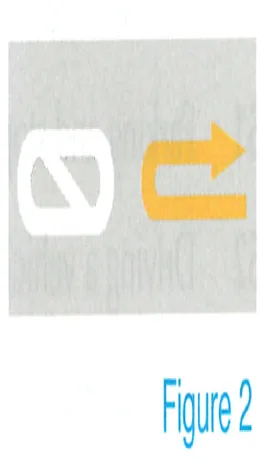
The pavement marking shown in Figure 2 designates the end of a no U-turn zone.
Answer: True
Question 7
When proceeding through a railway crossing behind another vehicle, there is no need to bring the vehicle to a complete stop if safety can be ascertained.
Answer: False
Question 8
If the road surface is wet from rain and the vehicle's tires are worn, the stopping distance may increase to as much as twice what it would have been if the road surface were dry and the tires in good condition.
Answer: True
Question 9
When making a right turn from a one-way street, an automobile must initially approach the center of the road and proceed inside the center point of the intersection while slowing down. (Except roundabout.)
Answer: False
Question 10
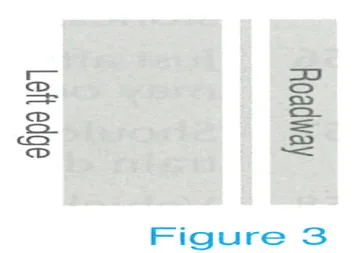
Bicycles may not use side strips as shown in Figure 3.
Answer: True
Question 11
Drivers of four-wheeled vehicles perceive two-wheeled vehicles to be closer and moving at a faster speed than they actually are.
Answer: False
Question 12
If pedestrians are splashed with mud or water, it is the responsibility of the driver, even if the driver is slowing down.
Answer: True
Question 13
When towing a broken-down vehicle using a rope, the person at the wheel of the vehicle being towed is not required to hold a license.
Answer: False
Question 14
When moving to the right-side lane and about to start overtaking, the driver should pay particular attention to traffic ahead and if he or she feels even a little uneasy, it is better not to begin overtaking.
Answer: True
Question 15
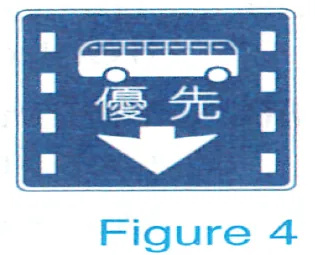
The traffic sign shown in Figure 4 designates that the lane may be used by regular vehicles, even in heavy traffic, if no local buses can be seen ahead or to the rear.
Answer: False
Question 16
Where the vehicular lane is marked off by a yellow line, vehicles must not cross the yellow line to change lanes, even if an emergency vehicle is approaching.
Answer: False
Question 17
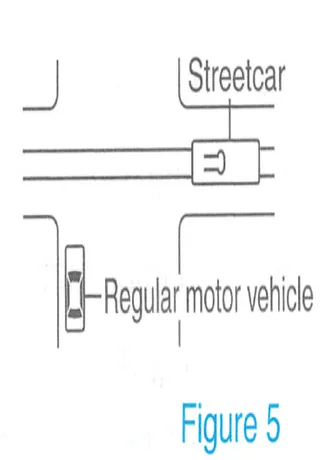
In the situation shown in Figure 5, the regular motor vehicle must yield the road to the streetcar.
Answer: False
Question 18
The level of battery fluid does not decrease, so there is no need to check it.
Answer: False
Question 19
When getting into a vehicle, the driver should check that there is no one in front or behind the vehicle and that there are no children under the vehicle.
Answer: True
Question 20
Overtaking is prohibited in tunnels whether there is a vehicular lane or not.
Answer: False
Question 21
Stopping is permitted within 10 meters of the signboard (marker post) of a bus stop or streetcar stop, even during business hours if it is to let passengers get in or out.
Answer: False
Question 22
In a vehicle with hydraulic brakes, if the brake pedal gradually becomes lower when it is pressed strongly, this indicates that brake fluid is leaking, which is a dangerous condition.
Answer: True
Question 23
If a vehicle's center of gravity becomes high and it leans to one side it is likely to turn over, so cargo must be loaded as low as possible and distributed to the left and right rather than on one side.
Answer: True
Question 24
The maximum permitted cargo height for regular motor vehicles (excluding three-wheeled vehicles and vehicles with an engine displacement of 660 cc or less) is, in principle, 3.8 meters from the cargo bed.
Answer: False
Question 25
Changing lanes or moving alongside an automobile or moped in order to overtake is prohibited at or within 30 meters before an intersection (excluding intersections of roads with right of way), railway crossing, pedestrian crossing, or bicycle crossing.
Answer: True
Question 26
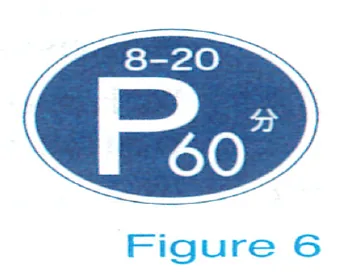
In a time-limited parking zone where there is a traffic sign as shown in Figure 6, vehicles are not permitted to park for more than 1 hour between 8:00 a.m. and 8:00 p.m. after the driver has operated a parking meter or been issued a parking ticket.
Answer: True
Question 27
Forgetting to turn off a signal confuses other drivers and increases the chance of an accident, so after completing an action a driver must stop signaling as soon as possible.
Answer: True
Question 28
When intending to overtake on a road with vehicular lanes, a driver must use the vehicular lane immediately to the right of the lane he or she is currently driving in.
Answer: True
Question 29
When a tire is punctured while the vehicle is in motion, the driver should not apply the brakes in panic, but rather should first grip the steering wheel firmly, keep the vehicle body straight, ease up on the accelerator to reduce speed, and then stop by gently applying the brakes.
Answer: True
Question 30
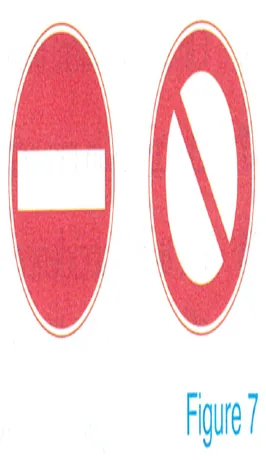
The two traffic signs shown in Figure 7 express the same meaning for all vehicles moving in the direction facing the signs.
Answer: True
Questions 31-60
Question 31
It is not true that all medicines are unsuitable for one who intends to drive, but it is best not to drive after taking medicine that causes drowsiness.
Answer: True
Question 32
Driving on expressways is comparatively less tiring for drivers because they do not need to watch out for pedestrians or traffic signals, so it is enough to rest once every 4 hours.
Answer: False
Question 33
When visibility is poor, such as when it is raining or at night, it is best to approach the vehicle ahead more closely than one would in clear weather or during the day in order to see it better.
Answer: False
Question 34
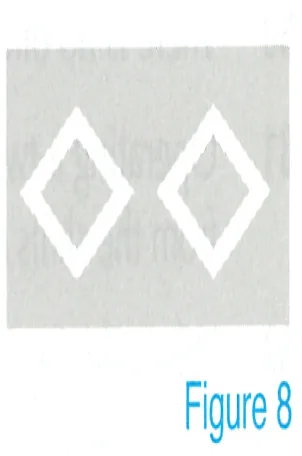
Where there is a pavement marking as shown in Figure 8, drivers should not accelerate or overtake.
Answer: True
Question 35
Drivers should use signals when intending to slow down or stop.
Answer: True
Question 36
When stopping on the shoulder of an expressway after a breakdown during the day, drivers of regular motor vehicles do not need to place an emergency warning reflector device as long as they turn on the hazard lights.
Answer: False
Question 37
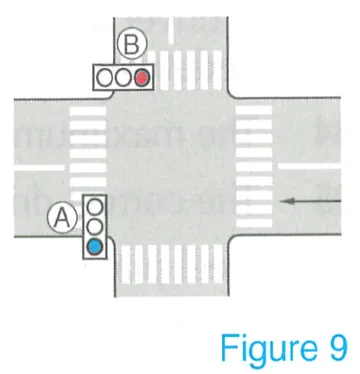
When intending to turn right at an intersection as shown in Figure 9 where traffic signal Ⓐ is green but traffic signal Ⓑ is red, the driver must stop inside the intersection and wait until traffic signal Ⓑ turns green.
Answer: False
Question 38
Any clothing is permitted when driving a vehicle as long as one is not naked.
Answer: False
Question 39
Stopping distance becomes longer if it is raining or the driver is tired, so it is necessary to lengthen the distance between vehicles.
Answer: True
Question 40
Drivers of four-wheeled vehicles tend to disregard two-wheeled vehicles.
Answer: True
Question 41
To overtake, drivers should signal using their direction indicators and then, gently change lanes while accelerating.
Answer: True
Question 42
A vehicle overtaking another vehicle may pass on the left side if there is sufficient space on the left side of the vehicle ahead.
Answer: False
Question 43
It is more difficult to see at night than during the day, but there is less traffic, the roads are less crowded, and it is less dangerous at night, so it is not necessary to drive at a lower speed than during the day.
Answer: False
Question 44
Driving while exceeding the seating capacity or loading restrictions noted on the motor vehicle inspection certificate can interfere with driving functions and may cause traffic accidents.
Answer: True
Question 45
Optional insurance coverage causes drivers to become complacent, making accidents likely to occur, so it is best not to purchase optional insurance.
Answer: False
Question 46
When a general moped is executing a right turn at an intersection where there are two lanes in each direction and there are no traffic signs indicating the appropriate method for executing right turns, the general moped must initially approach the intersection close to the center of the road and slow down just inside the center point of the intersection.
Answer: True
Question 47
A passenger vehicle with a seating capacity of 5 people may carry, in addition to the driver, 1 adult and 4 children under 12 years of age.
Answer: True
Question 48
Children become absorbed in things that catch their attention and may dash out onto the road suddenly, so drivers must pay special attention when driving in areas where children are present.
Answer: True
Question 49
When a vehicle's rear wheels slip sideways to the right, it is best to turn the steering wheel to the left.
Answer: False
Question 50
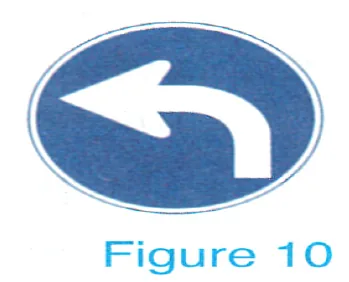
Where there is a traffic sign as shown in Figure 10, vehicles must turn left.
Answer: True
Question 51
Parking and stopping are prohibited near the top of an uphill slope or on a steep downhill slope, but not on a steep uphill slope.
Answer: False
Question 52
Driving a vehicle that produces noise because of a malfunctioning muffler or excessive smoke is not permitted, as it may disturb other people.
Answer: True
Question 53
When direction indicator lights are difficult to see, at sunset or other times, it is best to also use a hand signal that corresponds to the direction indicator operation.
Answer: True
Question 54
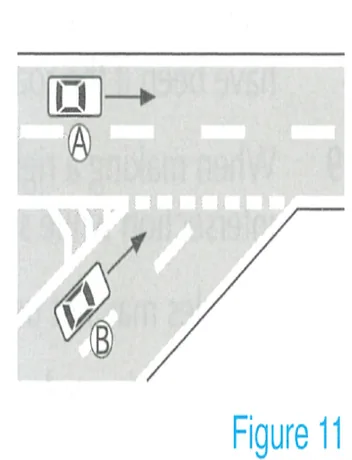
At the point where the main through lanes merge with traffic as shown in Figure 11, vehicle Ⓐ must not impede the progress of vehicle Ⓑ.
Answer: False
Question 55
When checking tires, check the tire pressure and tread depth and make sure that there are no cracks or any other damage, nails, stones, or any other foreign objects lodged in the tire, or abnormal wear.
Answer: True
Question 56
Just after starting or while the air conditioner is operating, the engine revolutions of automatic vehicles are high and jack-rabbit starts may occur, so drivers should be careful.
Answer: True
Question 57
Should a vehicle become immobilized inside a railway crossing due to a breakdown or similar, it is important for the driver to notify a train driver immediately and then move the vehicle promptly out of the crossing.
Answer: True
Question 58
Vehicles crossing a sidewalk or side strip must stop immediately before the sidewalk or side strip and take care not to impede the flow of pedestrian traffic, whether or not any pedestrians are present.
Answer: True
Question 59
The novice driver sign, which drivers who have been driving less than one year on a regular driver's license are required to display, may be affixed to either the front or rear of the vehicle.
Answer: False
Question 60
When passing oncoming traffic on narrow roads that have a cliff on one side with a dangerous drop, the vehicle on the side opposite from the cliff side should stop initially and allow the vehicle on the cliff side to go ahead.
Answer: False
Questions 61-90
Question 61
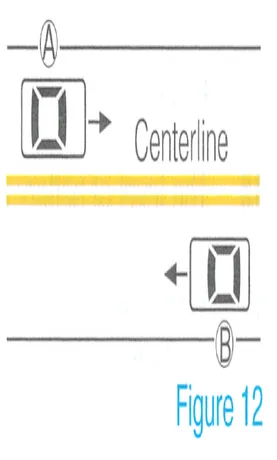
Where there is a pavement marking as shown in Figure 12, neither vehicle Ⓐ nor vehicle Ⓑ may enter the right side of the road for the purpose of overtaking.
Answer: True
Question 62
The designated maximum speed for large vehicles on general roads is 60 km/h for both passenger vehicles and trucks.
Answer: True
Question 63
If the hand signals of police officers or traffic wardens disagree with traffic signals, drivers should obey the traffic signals.
Answer: False
Question 64
An important point about driving safety is to know one's own personality and habits and drive in a way takes them into consideration.
Answer: True
Question 65
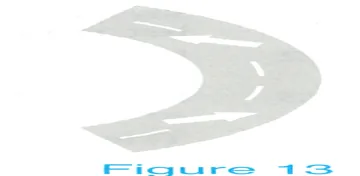
On a sharp curve where there is a pavement marking as shown in Figure 13, vehicles may enter the right side of the road and proceed but there may be oncoming traffic, so drivers must be careful.
Answer: True
Question 66
When driving an automobile past a safety zone, drivers must slow down whether or not pedestrians are present.
Answer: False
Question 67
If a truck traveling several vehicles ahead suddenly changes lanes or stops, it is best to think that something has happened ahead.
Answer: True
Question 68
If an accident occurs but the injury to those in the other vehicle is slight or the drivers of both vehicles can reach an agreement, it is not necessary to report the accident to the police.
Answer: False
Question 69
At night, when approaching intersections or curves with poor visibility, a driver should use the high beams or flash them to warn other drivers or pedestrians of the approach of the vehicle.
Answer: True
Question 70
In an intersection between roads with three lanes in each direction where the traffic signal is a red light and a green arrow pointing right, regular motor vehicles may proceed in the direction indicated by the arrow but mopeds may not proceed.
Answer: True
Question 71
Driving continuously at high speed with tires that are under inflated causes the dangerous "standing wave" phenomenon, so when driving at high speed, it is necessary to inflate the tires to a slightly higher pressure than that specified.
Answer: True
Question 72
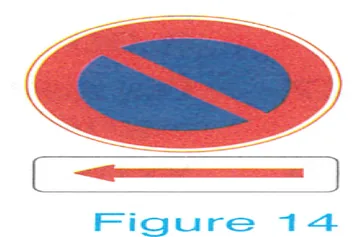
Where there is a traffic sign as shown in Figure 14, vehicles may park on the far side (behind) the traffic sign, but not on this side (in front) of the traffic sign.
Answer: True
Question 73
Eyesight deteriorates when suddenly entering a dark place from a bright place, but does not change when entering a bright place from a dark place.
Answer: False
Question 74
If an emergency vehicle is approaching on a one-way street that is not near an intersection, vehicles may give way to the emergency vehicle by moving to the right side of the road depending on the circumstances.
Answer: True
Question 75
When driving at night, it is necessary to pay particular attention to the tail lamps and brake lights of the vehicle ahead.
Answer: True
Question 76
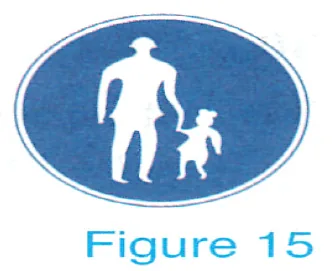
On a road where there is a traffic sign as shown in Figure 15, all types of vehicles may proceed, but they must slow down when pedestrians are present.
Answer: False
Question 77
On curves in mountain roads or similar, it is necessary while driving to anticipate that oncoming vehicles may cross the centerline.
Answer: True
Question 78
If a traffic accident occurs, the driver should move the vehicle to a safe place out of the way and turn off the engine to prevent interference with other traffic so that no follow-on accidents occur.
Answer: True
Question 79
If vehicles are traveling in a group, they must not engage in behavior that presents a danger to others or disturbs them, such as zigzagging or cutting off other vehicles.
Answer: True
Question 80
There is no difference between points to note when riding double on a large-size motorcycle, regular motorcycle, or when riding single.
Answer: False
Question 81
Operating a two-wheeled vehicle requires the skills of maintaining stability with one's body while driving and not losing stability when stopping, which differ from the skills required for driving four-wheeled vehicles.
Answer: True
Question 82
When driving on snow-covered roads, etc., a vehicle may slip or slide even when it is equipped with tire chains or snow tires, so it should maintain a sufficient vehicle distance, reduce its speed, and absolutely avoid sudden braking or swerving.
Answer: True
Question 83
A driver approaching a pedestrian crossing where another vehicle is stopped immediately before it may slow down and proceed if he or she does not see any pedestrians attempting to cross.
Answer: False
Question 84
The maximum speed for large-size trucks and specified medium trucks on the main through lanes of national expressways is 90 km/h.
Answer: True
Question 85
The correct driving posture for riders of two-wheeled vehicles is with knees apart and toes pointed out.
Answer: False
Question 86
Steel plates used in a construction site or similar become extremely slippery when wet, so drivers should sufficiently reduce speed before proceeding to avoid the necessity for sudden braking.
Answer: True
Question 87
Drivers must not think only of their own convenience, but rather must not disturb people living alongside the road by making unnecessary noise.
Answer: True
Question 88
To apply the brakes when riding a two-wheeled vehicle, it is best to maintain the vehicle body perpendicular to the road, prevent the steering wheel from turning, and apply the brakes to the front and rear wheels simultaneously while engaging in engine braking.
Answer: True
Question 89
Where there is a signboard that has a blue arrow pointing to the left on a white background at the left edge of a road or on a traffic signal, vehicles may turn left while watching out for surrounding traffic such as pedestrians, even if the signal ahead is red or yellow.
Answer: True
Question 90
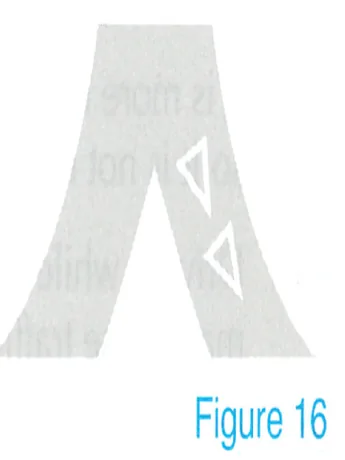
The pavement marking shown in Figure 16 designates that vehicles on the street have the right of way (and that vehicles at the upcoming intersection must yield to them).
Answer: False
Frequently asked questions
Why are there 90 Honmen questions in each set?
The official written examination is commonly described as 95 questions: 90 written true/false items plus five hazard-prediction illustration problems. These sets focus on the 90 written items.
What is the pass standard for the Honmen written exam?
Official materials commonly refer to a 90-point pass standard across the written and hazard-prediction sections. Confirm the current standard with your prefectural licence centre.
Should I study Karimen sets as well?
Yes. Honmen questions assume the rules tested at the Karimen stage, so the five Learner Permit sets remain useful revision while you prepare for the full licence exam.