
Honmen Practice Test Set 2 — 90 Final Exam Questions
This free practice set contains 90 Honmen questions in the same true/false format as the real knowledge test. The heaviest categories here are vehicle handling (14), general rules (13), traffic signals (12).
17 of the questions include road figures — signs, junction layouts and signal scenes — exactly the kind of visual items that cost marks when you meet them for the first time.
Read each explanation before moving on: every answer links back to the rule being tested. When you can score above 90% here, run the same set against the clock inside the free practice app.
Questions 1-30
Question 1
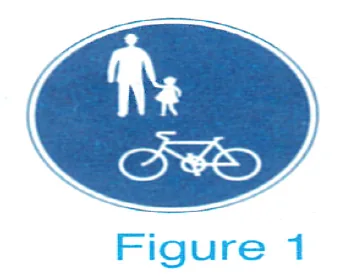
Where there is a traffic sign as shown in Figure 1, vehicles other than regular bicycles may not proceed.
Answer: True
Question 2
On the main through lanes of national expressways with two or more vehicular lanes, trailers must use the leftmost lane.
Answer: True
Question 3
The frictional resistance between tires and the road surface has a strong relationship to reaction distance.
Answer: False
Question 4
When a local bus is stopped at a bus stop and indicating its intention to enter traffic, vehicles approaching from behind must not obstruct its progress, unless not blocking the bus would require them to brake or swerve suddenly.
Answer: True
Question 5
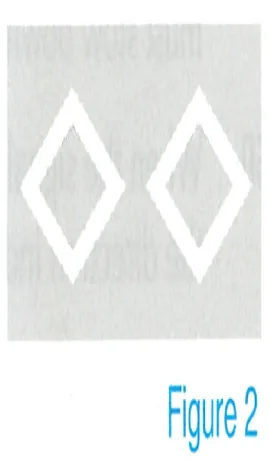
The pavement marking shown in Figure 2 indicates that a pedestrian crossing or bicycle crossing is ahead.
Answer: True
Question 6
It is advisable to check carefully around a stopped vehicle, including across the roof and under the vehicle, in order to be prepared for people who might emerge unexpectedly from behind it.
Answer: True
Question 7
When leaving a main through lane, reduce speed sufficiently while in the main through lane before entering the deceleration lane.
Answer: False
Question 8
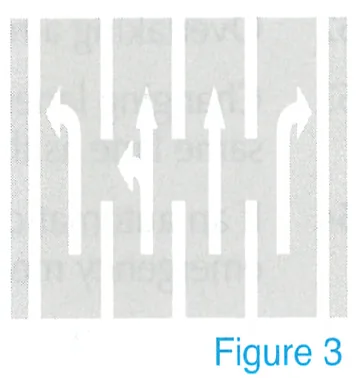
According to the pavement markings shown in Figure 3, even if separate lanes for traffic proceeding in different directions are designated at an intersection, vehicles may proceed in another lane if an emergency vehicle is approaching or if it is unavoidable due to road construction, etc.
Answer: True
Question 9
When passing oncoming traffic on mountain roads, the vehicle going uphill should give way to the vehicle going downhill.
Answer: False
Question 10
When a police officer holds a lamp straight up, this lamp signal has the same meaning as a yellow light for traffic proceeding in all directions.
Answer: False
Question 11
When driving a two-wheeled vehicle past a vehicle stopped in congested traffic, the driver should take care because a pedestrian may appear unexpectedly from behind the stopped vehicle or a door of the vehicle may suddenly open.
Answer: True
Question 12
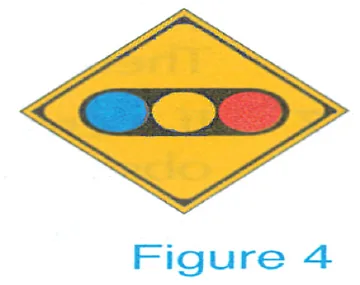
The traffic sign shown in Figure 4 indicates that a push-button type traffic signal is ahead.
Answer: False
Question 13
When choosing a two-wheeled vehicle, one must select a model appropriate for his or her body size. Even if he or she is confident of his or her strength, it is dangerous to suddenly try to ride a large vehicle.
Answer: True
Question 14
Large vehicles have a large wheelbase differential and there is also a blind spot (from the viewpoint of the driver) at the left rear, so drivers must be careful to avoid cutting off pedestrians or cyclists who may be proceeding on the left side of the vehicle.
Answer: True
Question 15
When towing a broken-down vehicle using a towing rope, the distance between vehicles must be 5 meters or less and a red cloth with an area of 0.3 square meters or more must be attached to the center of the rope.
Answer: False
Question 16
When passing an oncoming vehicle at night, the driver should dim the headlights or change their angle to point down so that they are not too bright for the oncoming vehicle, but when driving directly behind another vehicle, this is not necessary.
Answer: False
Question 17
Driving at the same speed, the braking distance of a vehicle is less when loaded with heavy cargo than when loaded with light cargo.
Answer: False
Question 18
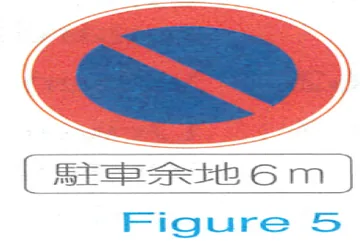
The traffic sign shown in Figure 5 designates that vehicles may park if the road is at least 6 meters wide.
Answer: False
Question 19
Roads must not be used as personal parking places for automobiles.
Answer: True
Question 20
On the main through lanes of expressways, crossing and U-turns are prohibited, but reversing the minimum necessary distance is permitted.
Answer: False
Question 21
When driving in fog, snowstorms or similar conditions, turn on fog lamps and headlights early, use the centerline, guard rail, and tail lamps of vehicles ahead as a guide, reduce speed, and if necessary sound the horn.
Answer: True
Question 22
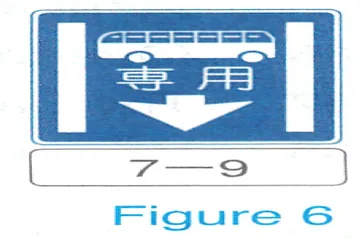
In a lane where there is a traffic sign as shown in Figure 6, regular motor vehicles may proceed at 8:00 p.m.
Answer: True
Question 23
A general moped executing a two-step right turn must keep its right turn signal on until it has proceeded straight ahead to the place at which it turns right.
Answer: True
Question 24
When checking the chain of a two-wheeled vehicle by pressing the middle of the chain with one's finger, there should be no slack and it should be tight.
Answer: False
Question 25
When there is a side strip designated by a single white line, a vehicle may enter the side strip to stop and park if there is 0.75 meters or more of space on the left side of the vehicle.
Answer: True
Question 26
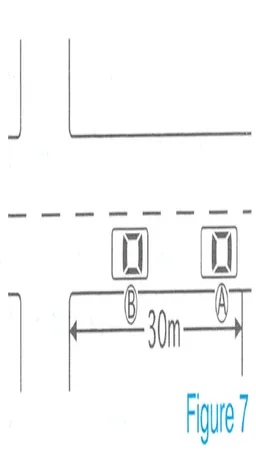
In the situation shown in Figure 7, vehicle (A) must not overtake vehicle (B), even if it is safe ahead and to the rear.
Answer: False
Question 27
On a snow-covered road, the wheel prints made by previous vehicles are extremely slick, so drivers must avoid the prints as much as possible.
Answer: False
Question 28
Daily checks include not only those performed when the vehicle is stopped, but also those performed during driving.
Answer: True
Question 29
If travel plans put undue strain on the driver or vehicle, the driver's care may be lacking, his or her attention may be reduced, and he or she may tend to drive too fast without noticing. Drivers should allow for leeway when making travel plans.
Answer: True
Question 30
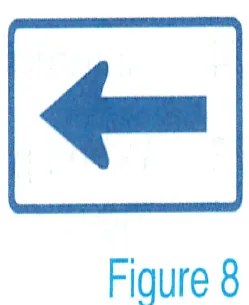
At an intersection where there is a signboard as shown in Figure 8, automobiles and general mopeds may turn left even if the signal is yellow or red, but specified small mopeds or light vehicles may not.
Answer: False
Questions 31-60
Question 31
When driving at night, even with the headlights on one cannot see far away, so it is advisable to train one's eyes immediately to the front of the vehicle.
Answer: False
Question 32
The length of cargo loaded onto a regular truck may be up to 1.2 times the length of the vehicle.
Answer: True
Question 33
When starting a four-wheeled vehicle on an uphill slope, use the parking brake as much as possible so as not to roll back.
Answer: True
Question 34
Drivers must take care that passengers do not open the doors carelessly.
Answer: True
Question 35
Vehicles crossing a sidewalk or side strip in order to enter or leave a roadside gas station must stop immediately before the sidewalk or side strip if there are pedestrians, but if no pedestrians are present, vehicles may slow down and proceed.
Answer: False
Question 36
Close objects become more difficult to see when driving at 60 km/h than when driving at 30 km/h.
Answer: True
Question 37
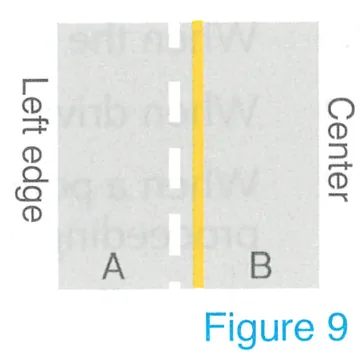
Where there is a pavement marking as shown in Figure 9, vehicles traveling in lane A must not change lanes into lane B.
Answer: False
Question 38
Overtaking is prohibited along steep downward slopes, but not steep upward slopes.
Answer: True
Question 39
The appropriate time to signal a left or right turn to exit the road is 30 meters before reaching the point where the turn will be made.
Answer: True
Question 40
The engine oil level must be kept within the range indicated on the oil level gauge (between F and L).
Answer: True
Question 41
Using a mobile phone or looking at the screen of a car navigation system while driving is distracting and can lead to an accident, so drivers must not engage in these activities.
Answer: True
Question 42
If there is a person crossing a pedestrian crossing, but he or she stops when a vehicle approaches, the vehicle may continue to proceed as before.
Answer: False
Question 43
When moving into traffic from the edge of the road, it is not particularly necessary to signal if the driver makes sure there is no vehicle approaching from the rear.
Answer: False
Question 44
When intending to overtake another vehicle, a vehicle should reduce the clearance between it and the vehicle to be overtaken as much as possible in order to avoid a head-on collision with an oncoming vehicle.
Answer: False
Question 45
Drivers of vehicles with a malfunctioning steering wheel or brakes must slow down and take care while driving.
Answer: False
Question 46
At the railway crossings where visibility is good, vehicles may slow down and proceed if safety can be ascertained.
Answer: False
Question 47
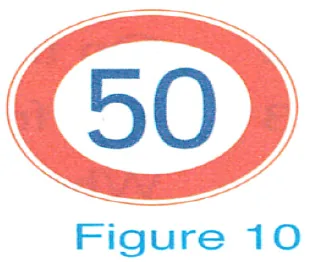
On a road where there is a traffic sign as shown in Figure 10, general mopeds must not exceed a speed of 30 km/h.
Answer: True
Question 48
Two people may not ride a general moped at one time.
Answer: True
Question 49
When small children walking unattended, senior citizens, people with physical disabilities, or others with difficulty walking are passing, drivers must slow down or stop to allow them to pass safely.
Answer: True
Question 50
When the signal ahead is a red light and a green arrow pointing to the left at the same time, automobiles and general mopeds may proceed in the direction indicated by the arrow, but light vehicles may not proceed.
Answer: False
Question 51
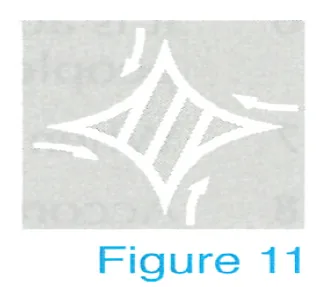
At an intersection where there is a pavement marking as shown in Figure 11, an automobile making a right turn must slow down outside the center of the intersection.
Answer: False
Question 52
Overtaking a regular motor vehicle that is attempting to overtake a general moped is not prohibited double overtaking.
Answer: True
Question 53
Changing lanes unnecessarily creates a nuisance for drivers further behind, and can lead to accidents. Therefore, vehicles must remain in the same lane as they proceed as much as possible.
Answer: True
Question 54
If an automatic transmission vehicle's engine stalls and will not turn over, it can be moved by putting the gear shift in (D) and using the starter motor as an emergency measure.
Answer: False
Question 55
The main through lane is the part of an expressway for ordinary high-speed traffic (not including acceleration lanes, deceleration lanes, slower traffic lanes, side strips, and road shoulders).
Answer: True
Question 56
When it rains, pedestrians pay attention to their footing and their field of vision is blocked by rain gear, so they may not notice the approach of a vehicle. Therefore, drivers must pay careful attention to their movements.
Answer: True
Question 57
If a cross street is a road with right of way or it is wider, a vehicle must slow down and, depending on the situation, it may have to stop so as not to obstruct the progress of vehicles proceeding on the cross street.
Answer: True
Question 58
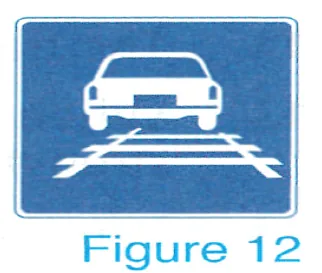
Where there is a traffic sign as shown in Figure 12, only regular motor vehicles are allowed to drive on streetcar tracks.
Answer: False
Question 59
Parking is prohibited within 3 meters of the entrance to a garage, but the owner of the garage or related persons may park in front of a garage.
Answer: False
Question 60
Two-wheeled vehicles are often overlooked by the drivers of four-wheeled vehicles, so when riding a two-wheeled vehicle, wear bright colored clothes and a helmet that are highly visible.
Answer: True
Questions 61-90
Question 61
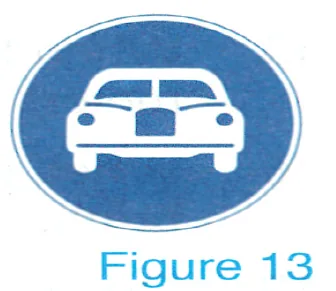
On a road where there is a traffic sign as shown in Figure 13, general mopeds may not proceed but large or regular motorcycles may proceed regardless of engine displacement.
Answer: False
Question 62
When overtaking a streetcar on a road where there are rails in the center, vehicles must pass on the right side.
Answer: False
Question 63
Driver's license and equivalent may be renewed within the period of time; starting two months prior to the birthday that is prior to the expiration date of the term of validity, up to the expiration date itself.
Answer: False
Question 64
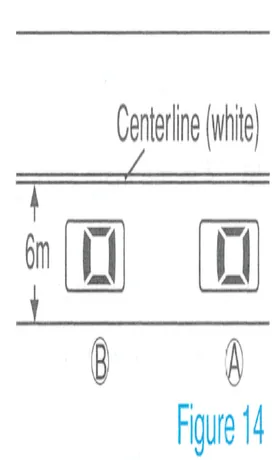
In the situation shown in Figure 14, vehicle Ⓐ may cross to the right to a minimum extent and overtake vehicle Ⓑ.
Answer: False
Question 65
In the main through lanes of motorways with no maximum speed limit indicated, the designated maximum speed for regular motor vehicles is 60 km/h.
Answer: True
Question 66
Overtaking is prohibited at a pedestrian crossing or bicycle crossing or within 30 meters before one, but passing is not prohibited.
Answer: False
Question 67
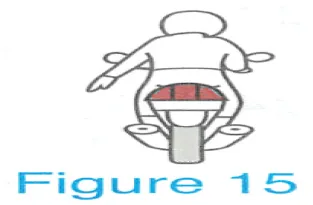
The hand signal shown in Figure 15 is the signal for slowing down or stopping.
Answer: True
Question 68
When depressing the brake pedal of a four-wheeled vehicle all the way, it is best if there is a little space between the pedal and the floorboard (pedal reserve distance).
Answer: False
Question 69
Driving while one is feeling uneasy, is extremely tired, or is in poor physical condition can lead to accidents. Drivers should not drive in these circumstances.
Answer: True
Question 70
On a road where the left side is less than 6 meters wide and the centerline is a solid yellow line, vehicles may not cross the line to enter the right-hand part of the road for the purpose of overtaking.
Answer: True
Question 71
Carrying cargo in the cargo bed in such a manner that it obstructs a clear view of the vehicle's direction indicators, tail lamps, brake lights, license plate, etc. is permitted if a person to observe the cargo rides along.
Answer: False
Question 72
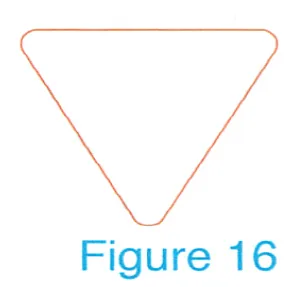
There are only two types of traffic signs of the shape shown in Figure 16: "slow down" and "stop."
Answer: True
Question 73
Stopping and parking are prohibited inside railway crossings and areas within 10 meters of the front or rear edge of a railway crossing.
Answer: True
Question 74
Automobiles must be covered by compulsory automobile liability insurance or mutual relief system insurance, but mopeds need not be.
Answer: False
Question 75
When parking or stopping a regular motor vehicle on an ordinary road without road illumination at night, the driver must turn on the hazard lights, parking lights, or tail lamps, or display an emergency warning reflector device, so that other drivers can see that his or her automobile is stopped or parked.
Answer: True
Question 76
When passing around a curve it is advisable to reduce speed just before the curve and enter it slowly, and then gradually accelerate slightly before completing the turn around the curve.
Answer: True
Question 77
In places where crossing and U-turns are prohibited by traffic signs or pavement markings, driving in reverse is also prohibited.
Answer: False
Question 78
The maximum speed limit for regular motor vehicles with an engine displacement of 660 cc or less in the main through lanes of national expressways is 80 km/h.
Answer: False
Question 79
Passing too close to or cutting in front of a regular vehicle that is displaying a sign indicating a novice driver, senior driver, or physically disabled driver is prohibited, but there are no such regulations relating to a regular vehicle displaying a learner driver sign.
Answer: False
Question 80
When the lights of an oncoming vehicle are too bright, it is advisable not to stare but rather to move one's gaze ahead somewhat to the left.
Answer: True
Question 81
When driving a two-wheeled vehicle in the summer, the driver should wear cool garments such as short-sleeved shirts and shorts.
Answer: False
Question 82
When a police officer holds his or her arms straight out to the sides horizontally, this has the same meaning as a red light for traffic proceeding toward the front or back of the officer.
Answer: True
Question 83
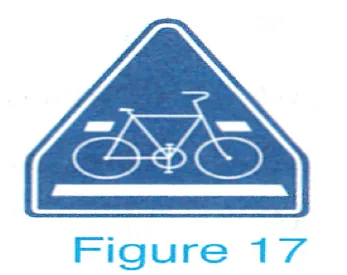
The traffic sign shown in Figure 17 designates a bicycle path or a dedicated road for bicycles.
Answer: False
Question 84
Automotive emissions contain harmful gases such as carbon monoxide, hydrocarbons, and nitrogen oxides, and are a source of air pollution.
Answer: True
Question 85
Automatic transmission vehicles never need to change the position of the gear shift from (D) (drive) while driving, even on long or steep downward slopes.
Answer: False
Question 86
A maximum speed limit is designated on national expressways, so even when it is raining or the weather is bad, the driver must drive as quickly as possible.
Answer: False
Question 87
Colliding with a concrete wall at 60 km/h has the same impact force as falling from a height of about 14 meters (a five-story building).
Answer: True
Question 88
When drivers are unavoidably forced by an earthquake to leave their vehicle on the road and move to a safe location, they should pull over to the left and park, stop the engine, and leave the key in the ignition or in a visible location (such as the driver's seat). Drivers of four-wheeled vehicles should close the windows and leave the doors unlocked.
Answer: True
Question 89
Vehicles must slow down at intersections with poor visibility to the left or right (excluding controlled intersections equipped with traffic signals, etc. and cases where the driver is proceeding on a road with the right of way), but depending on traffic conditions, it may be necessary to stop.
Answer: True
Question 90
When driving a regular motor vehicle, if the vehicle cannot be driven further on an expressway due to a breakdown, etc., the driver must place an emergency warning reflector device to the rear of the vehicle. At night (or during the day when visibility is 200 meters or less), in addition to putting out an emergency warning reflector device the driver must also turn on the hazard lights, parking lights, or tail lamps.
Answer: True
Frequently asked questions
Why are there 90 Honmen questions in each set?
The official written examination is commonly described as 95 questions: 90 written true/false items plus five hazard-prediction illustration problems. These sets focus on the 90 written items.
What is the pass standard for the Honmen written exam?
Official materials commonly refer to a 90-point pass standard across the written and hazard-prediction sections. Confirm the current standard with your prefectural licence centre.
Should I study Karimen sets as well?
Yes. Honmen questions assume the rules tested at the Karimen stage, so the five Learner Permit sets remain useful revision while you prepare for the full licence exam.